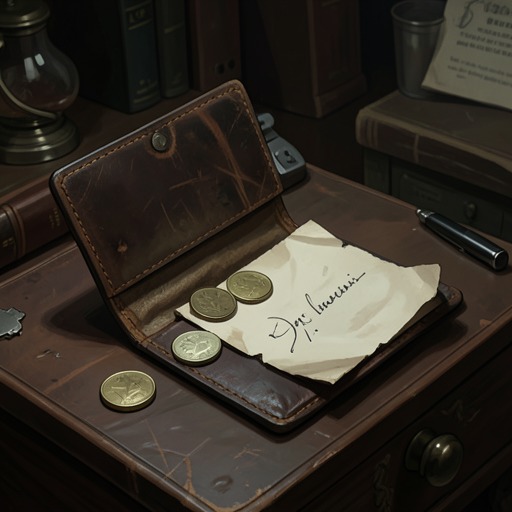
Magwitch’s pocket-book
Great ExpectationsMagwitch’s pocket-book is a consequential record of the convict’s property and his intended provision for Pip. Its passage from Pip’s keeping into an officer’s custody marks a reversal: the wealth Magwitch had meant to pass on is documented, but neither Pip’s affection for him nor the information in the book can overcome the Crown’s claim to a convicted outlaw’s property.
Intended Inheritance
While imprisoned, Magwitch gave Mr. Jaggers a list of possessions he believed Pip would inherit. The list included money held at a banking-house in New South Wales and land of considerable value. The pocket-book therefore connects Magwitch’s accumulated wealth to his plan to make Pip a gentleman, while revealing how little Pip understood the legal conditions governing that fortune.
The book’s importance lies not simply in identifying assets but in showing the difference between Magwitch’s intention and Pip’s enforceable rights. Magwitch believed the inheritance was secure with Mr. Jaggers’s assistance. Yet no writing or settlement had been made in Pip’s favour before Magwitch’s apprehension, and Pip had no legally recognizable connection to the outlaw that could establish a claim.
Custody After the Capture
After Magwitch was captured, Pip asked the officer’s permission to obtain spare clothes for him from a public-house. The officer agreed, while insisting that he must take charge of everything the prisoner had with him. Under that rule, the pocket-book passed out of Pip’s hands and into the officer’s custody. Pip was allowed to accompany Magwitch to London, but his two friends were not.
The transfer makes the pocket-book part of the state’s handling of Magwitch’s possessions, rather than a private document Pip can use to secure the inheritance. Its custody changes at the same moment Pip’s practical relationship to Magwitch changes: he remains beside him, but cannot control the property or the legal process closing around it.
Evidence and Forfeiture
After the informer’s body was recovered, notes among his effects indicated that he had known about Magwitch’s affairs. They named the New South Wales banking-house where money was held and identified valuable land. Both details matched the information Magwitch had given Mr. Jaggers for the list of possessions he supposed Pip would inherit. The pocket-book’s associated record thus gains significance as part of a wider chain of information about Magwitch’s property and the informer’s knowledge of it.
Pip told Mr. Jaggers that he intended to keep Magwitch ignorant of the fate of his wealth. Mr. Jaggers reproached him for letting the property slip away and said they could later petition and try to recover some of it. He nevertheless made clear that the circumstances offered no basis for avoiding forfeiture. Pip understood that he had no claim and resolved not to pursue one, refusing to let a hopeless attempt to establish ownership consume him.
Narrative Significance
The pocket-book gathers the novel’s conflict between personal obligation and formal property rights into a single portable record. Magwitch’s savings embody years of effort and his determination to reward Pip; the information attached to them confirms that this imagined inheritance had material substance. But the state’s forfeiture rules and the absence of a settlement prevent Magwitch’s generosity from becoming Pip’s lawful property.
Its changing custody also sharpens the gap between possession, knowledge, and entitlement. Pip has held the book, then sends it back through Herbert to be kept safe while he refuses further benefit from Magwitch. Later, the officer takes charge of it as part of the prisoner’s effects. The object survives those changes of hands as evidence of a fortune Pip once expected, then chose not to claim.